
Gasket Solutions for Valve Sealing Applications
Facing a critical valve challenge? Mercer Gasket & Shim delivers precision-engineered sealing solutions for valves, whether you need a single emergency replacement for Maintenance, Repair, and Operations (MRO) or high-volume production for Original Equipment Manufacturers (OEMs). Backed by decades of experience serving diverse industries where reliable fluid control is paramount, we have the expertise and advanced manufacturing capabilities to meet your exact specifications for valve sealing.
Ready to discuss your valve sealing requirement? Contact us today! Keep reading to learn more about the industries we serve and the sealing solutions we provide, or contact us and speak with a sealing expert.
Industries Served
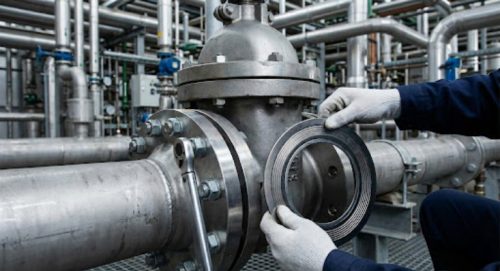 Valves are the control points of any fluid system, and their seals are critical for isolating, throttling, and diverting media without leakage.
Oil and Gas: Valves—like ball, gate, and globe valves—are essential for controlling the flow of crude oil, natural gas, and refined products at every stage. High-integrity valve stem and bonnet seals are critical for preventing fugitive emissions, ensuring safety, and maintaining strict environmental compliance in high-pressure and high-temperature environments.
Chemical Processing: In applications handling corrosive acids, solvents, and high-purity chemicals, reliable valve seals are vital for containing hazardous materials. Robust stem packing and body gaskets prevent external leaks and ensure that the process media is not contaminated, maintaining process integrity and safety.
Water and Wastewater Treatment: Control valves, check valves, and isolation valves regulate the massive flow of water and sewage. Durable, water-resistant valve seals prevent leaks that could lead to water loss or infiltration of contaminants, ensuring the efficiency and sanitation of public health infrastructure.
Power Generation: Power plants rely on valves to control high-pressure steam for turbines and manage cooling water flow. High-performance valve packing and gaskets are essential for withstanding extreme thermal cycling and pressure, preventing steam leaks, and maximizing energy production efficiency.
HVAC and Refrigeration: Valves regulate the flow of refrigerants, chilled water, and hot water in commercial systems. Dependable valve seals prevent leaks of expensive refrigerants or circulating media, ensuring the energy efficiency and proper functioning of large-scale climate control systems.
Food and Beverage: Sanitary diaphragm and butterfly valves are used to control the flow of ingredients and finished products. Hygienic valve seals are paramount for preventing microbial growth, cross-contamination, and meeting stringent health and sanitation regulations.
Pulp and Paper: Valves manage abrasive pulp slurry, corrosive chemicals, and large volumes of water throughout the paper-making process. Resilient valve seals are necessary to withstand erosion and chemical attack, ensuring operational continuity and reducing maintenance needs.
Marine: Control valves are used extensively on ships for ballast, fuel, and engine cooling systems. Valve seals in this environment must be highly resistant to saltwater corrosion and capable of maintaining a seal under the ship’s constant vibration and movement.
Manufacturing: Valves control cooling fluids, hydraulic oils, and specialized gases in various production processes. Effective valve seals prevent leaks that could lead to system downtime, equipment damage, and inefficient material use.
Commonly Used Sealing Solutions for Valves
Valve Gaskets (Body and Bonnet)
Why: Gaskets are primarily used to seal the joint between the main valve body and the bonnet (the cover that holds the internal components). They create a static, pressure-tight seal that is essential when the valve is assembled and during maintenance. Materials range from compressed non-asbestos fiber and PTFE for general service to spiral wound gaskets for high-pressure, high-temperature applications.
Where: They are found in nearly all bolted valve assemblies, including gate, globe, check, and pressure relief valves. These seals are a core requirement for both OEM fabrication and MRO rebuilds during valve overhaul.
Valve Stem Packing
Why: Packing is the critical sealing element around the valve stem—the moving rod that opens and closes the valve. Unlike static gaskets, stem packing is a dynamic seal designed to prevent fluid loss around a moving part. It is typically constructed of braided rings (like PTFE, graphite, or aramid) that are compressed into a stuffing box to create a reliable seal while allowing the stem to rotate or slide.
Where: Stem packing is essential for all manual and actuated valves that utilize a sliding or rotating stem, such as gate, globe, ball, and control valves. It is one of the most common MRO components for preventing fugitive emissions.
O-Rings
Why: O-rings are often used in internal valve components, such as sealing the seats or around the spool in hydraulic and pneumatic control valves. They are elastomeric seals (e.g., Buna-N, Viton, EPDM) that provide an excellent, cost-effective static seal in a confined groove under moderate temperature and pressure. Their simplicity makes them ideal for high-volume, precision sealing.
Where: Common in small-bore, high-cycle, or precision valves like solenoid valves, small ball valves, and instrument valves. They are a staple for both OEM design and specific MRO cartridge replacements.
Factors Influencing Valve Sealing Solution Selection
The choice of a sealing solution for a valve application is highly dependent on how the valve is used and the environment it operates in:
- Fluid Characteristics: The media’s corrosivity, temperature, and pressure dictate the required material compatibility and thermal resistance of the seal. This is crucial for both the body gasket and the stem packing.
- Valve Operation and Cycle Rate: For dynamic seals like stem packing, the frequency of valve actuation (e.g., how often the valve is opened and closed) is critical. High-cycle applications require more durable, low-friction packing materials.
- Fugitive Emission Requirements: Strict regulations (e.g., EPA or API standards) regarding leakage of volatile organic compounds (VOCs) require specialized, low-emission packing designs, often utilizing high-density graphite or advanced PTFE compounds.
- Operating Conditions: Extreme temperatures, high pressures, or the presence of aggressive steam or gas necessitate highly robust materials and advanced sealing designs to maintain integrity over the valve’s lifespan.
- Maintenance Requirements and Lifespan: The desired service life of the valve and the ease of replacing the packing or gasket are important considerations for both MRO inventory and OEM total cost of ownership.
Mercer’s experienced team considers all of the above to provide expert guidance in valve sealing solution selection. We carefully consider critical factors to ensure your fluid control systems operate with optimal safety, efficiency, and environmental compliance. We’re committed to helping you find the perfect sealing solution for your specific industry and valve application, whether for MRO or OEM needs. Contact the Mercer team today!